
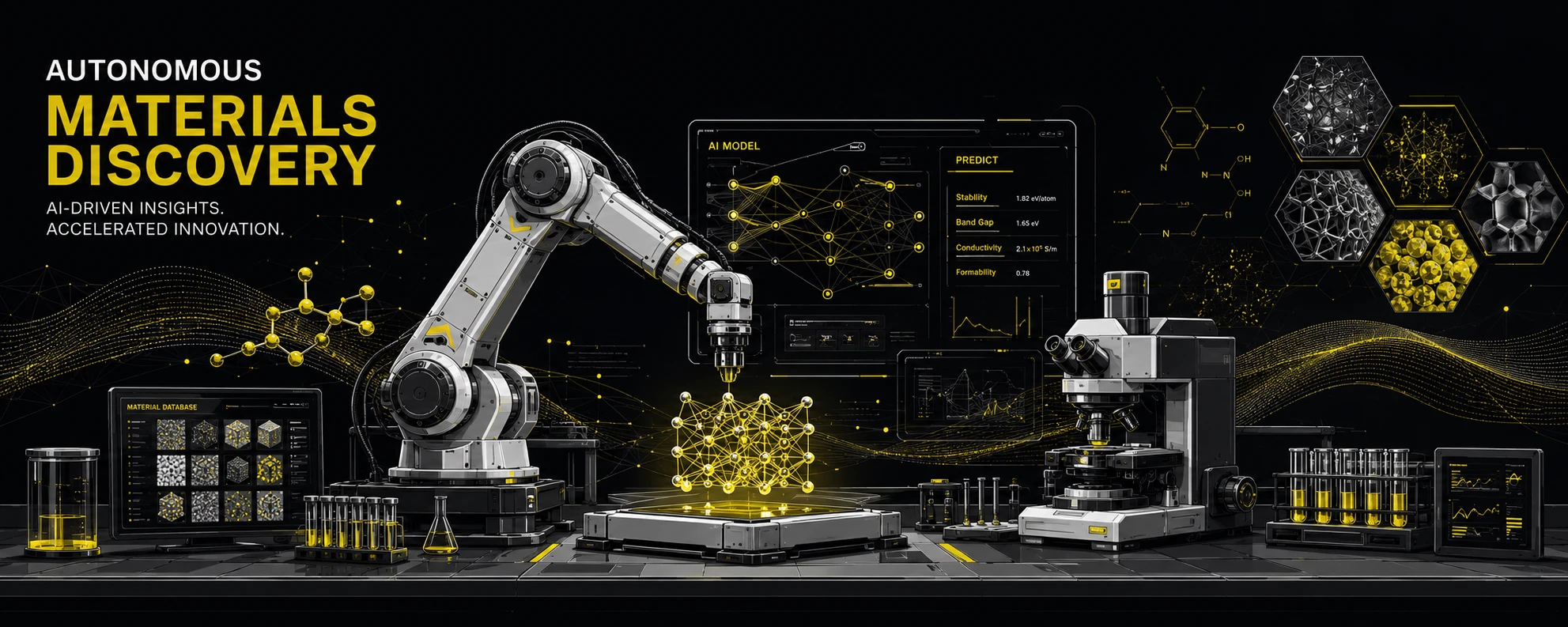
Autonomous Materials Discovery: How AI Is Rewriting the Discovery Loop
Every technology you rely on is gated by a material that had to be found first. The lithium in a battery, the gallium nitride in a fast charger, the nickel superalloy in a jet turbine, the low-loss steel in a transformer core: each represents a search that, historically, took a decade or more. The Ceder group at Berkeley puts the industry average bluntly: from an idea to a material on the market is often more than ten years, most of it lost to manual, labor-intensive experimentation.
That timeline is now under active assault. This guide walks through what materials discovery actually is, how it is measured, where AI creates leverage, and what it means when a laboratory starts running the whole loop by itself.
What materials discovery actually is
Materials discovery is the search for a substance whose properties meet a target, and the process that reliably produces it. The discipline organizes that search around one idea, sometimes called the materials paradigm or the process-structure-property-performance chain:
- Process: how the material is made: composition, synthesis route, thermal history, deformation.
- Structure: what results, from the crystal lattice down to grain boundaries, phases, and defects.
- Property: the intrinsic response: strength, conductivity, band gap, corrosion resistance.
- Performance: how the finished part behaves in service, under load, heat, and time.
The chain runs both ways. Read forward, processing decisions propagate up to performance. Read backward, a performance requirement becomes an inverse problem: what structure, and therefore what process, delivers it? Discovery is that inverse problem solved at scale.
The link that makes the paradigm concrete is the one between structure and property. Consider the yield strength of a metal, the stress at which it stops springing back and starts to deform permanently. That behavior is governed not by the bulk crystal but by line defects called dislocations, which glide along slip planes when shear stress is applied.
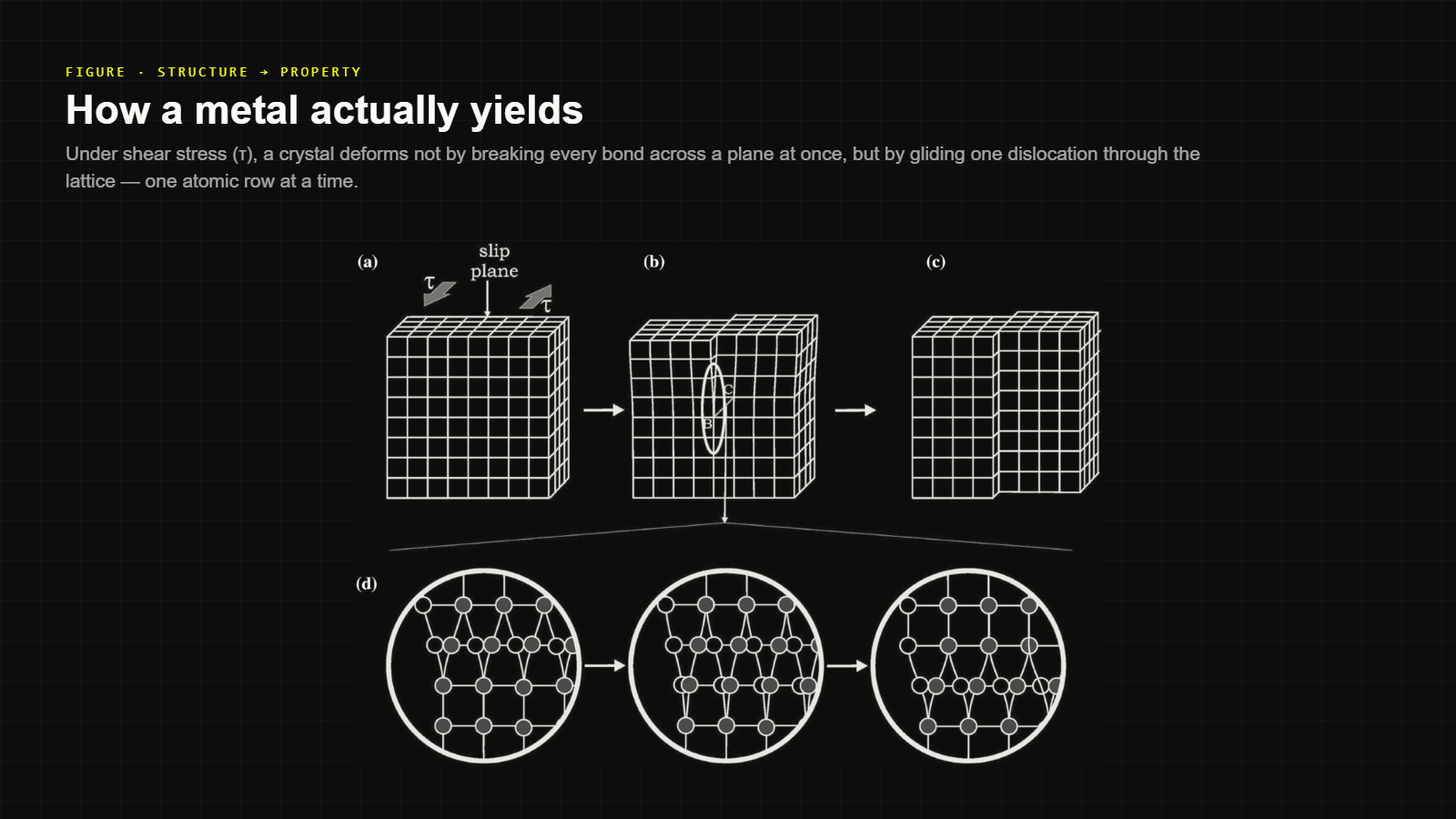
Everything a metallurgist does to strengthen an alloy, such as refining the grain size, adding solute atoms, precipitating a second phase, is an effort to make dislocations harder to move. That is the paradigm in miniature: a processing choice alters the structure, the structure alters a property, and the property decides whether a component survives. Discovery is the systematic exploration of that map.
Measuring the material: characterization
You cannot discover what you cannot measure. Characterization is the set of experimental techniques that reveal a material's structure, composition, and properties, and it is where most of the time and instrumentation in a lab actually go. It divides into a few families.
Structural methods answer what and where. X-ray diffraction (XRD) fingerprints crystal phases; scanning and transmission electron microscopy (SEM, TEM) image morphology, grain structure, and defects; electron backscatter diffraction (EBSD) maps grain orientation. Compositional methods answer what is it made of: energy-dispersive spectroscopy (EDS), X-ray photoelectron spectroscopy (XPS), and mass spectrometry quantify elements and chemical states. Mechanical testing consists of rigorously testing tensile, hardness, fatigue, fracture toughness, nanoindentation characteristics, measuring how the material carries load. Thermal analysis (DSC, TGA, DMA) tracks phase transitions and stability with temperature.
Semiconductors and functional electronic materials add their own layer, because the properties that matter are electronic and optical rather than mechanical. For a structural alloy, the decisive tests are mechanical and microstructural. For a semiconductor, they shift to Hall-effect measurements (carrier concentration and mobility), four-point probe resistivity, capacitance-voltage and current-voltage curves, photoluminescence, and ellipsometry for thin-film optical constants. Different physics, same purpose: convert a physical sample into numbers a decision can be made on.
Those numbers only matter because they predict behavior. A property measured on a coupon has to translate into how a part performs, a processing lever such as grain refinement raises yield strength through the Hall-Petch relation, which in turn extends the fatigue life of the finished component. Discovery is only useful when the chain closes all the way to performance.
How AI compresses the search
The reason discovery is slow is arithmetic. The space of possible materials, which is a combinations of elements, stoichiometries, and structures, is astronomically large, often quoted at the order of 10⁶⁰ candidate compositions. No experimental program can traverse that. AI attacks the problem on three fronts.
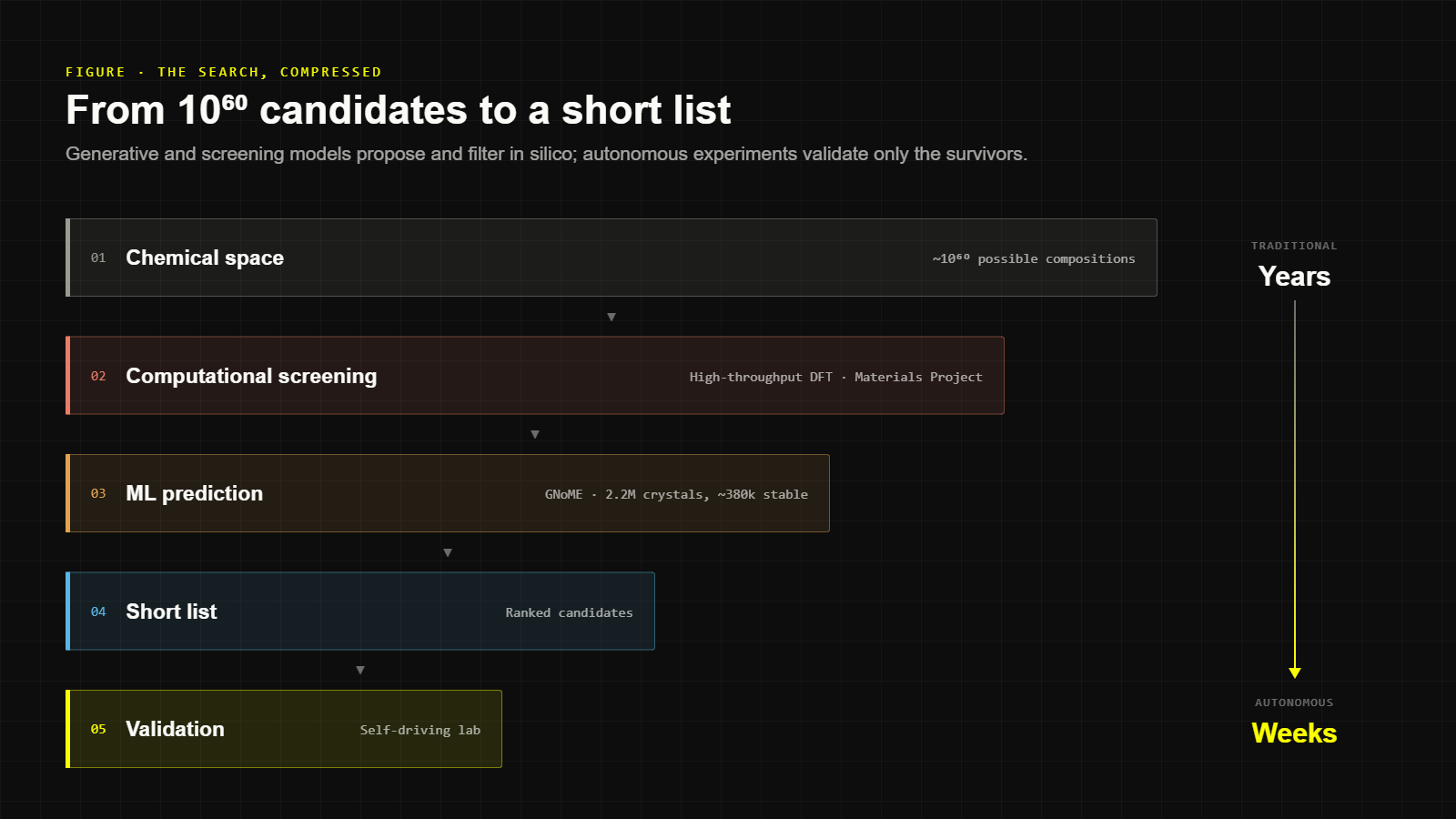
The first front is in silico screening. High-throughput density functional theory (DFT), pioneered at scale by efforts like the Materials Project, computes properties for hundreds of thousands of hypothetical compounds before anything is synthesized. Machine-learned interatomic potentials now approximate that quantum-mechanical accuracy at a fraction of the cost, and generative models propose entirely new candidate structures aimed at a target property. Google DeepMind's GNoME predicted roughly 2.2 million new crystals, about 380,000 of them likely stable, an expansion of the known stable-materials set that no manual campaign could match.
The second front is interpretation. Characterization produces data faster than humans can read it, and that backlog is a genuine bottleneck. Machine learning now automates the reading: the Ceder group built probabilistic deep-learning models to identify phases from multi-phase diffraction patterns without a human at the diffractometer, and Radical AI reports automating microstructure analysis across a trove of ten thousand SEM images, a scale of visual analysis that would take a graduate student years.
The third front is decision-making. Rather than test candidates in an arbitrary order, active learning and Bayesian optimization choose the next experiment to run, the one expected to teach the most, turning a blind search into a directed one. This is what makes the loop worth closing: if the machine can decide what to try next, it no longer needs to wait for a human between steps.
The autonomous laboratory
An autonomous, or self-driving, laboratory is a system that runs the full discovery loop without a human in the middle: it proposes a hypothesis, executes the synthesis with robotics, characterizes the result with automated instruments, interprets the data with machine learning, and decides what to do next, then repeats.
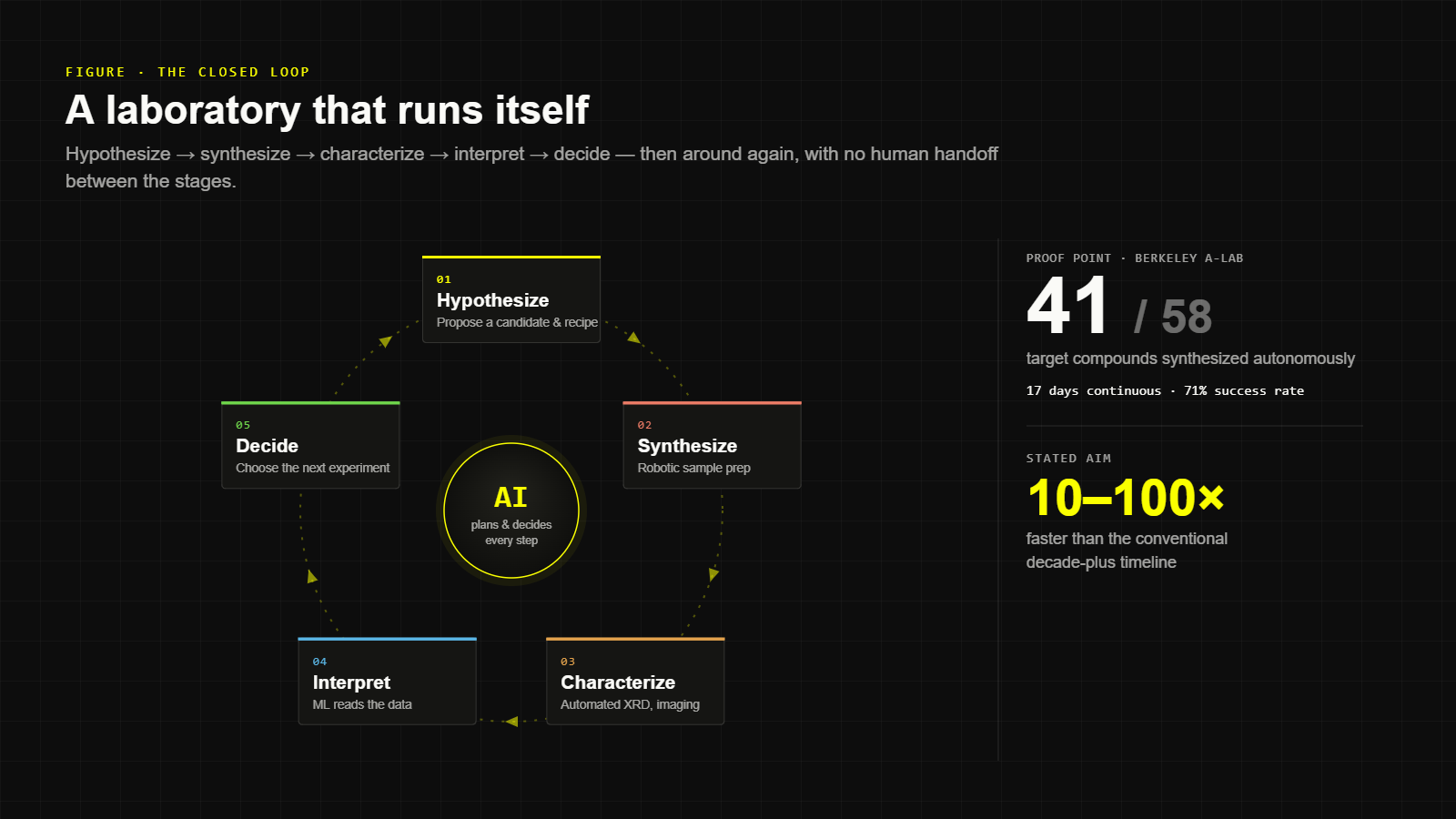
The clearest proof point is Berkeley's A-Lab. Integrating computational targets from the Materials Project and GNoME with robotic synthesis, automated XRD, and machine-learned analysis, it ran for seventeen days and produced 41 of 58 target compounds, a 71% success rate, proposing and refining its own synthesis recipes along the way. The group's stated aim is a discovery rate 10 to 100 times faster than the conventional standard.
Two things make this more than automation. First, the loop generates data that exists nowhere else, including negative results, the failed syntheses that rarely reach publication but are exactly what a model needs to learn synthesizability. Periodic Labs frames this as the core asset: internet text is finite and largely exhausted for frontier models, so the frontier now runs through experiments, where, as they put it, nature itself is the environment the system learns against. Second, the loop compounds. Every iteration sharpens the model that plans the next one.
The landscape
The field is no longer confined to academia. A handful of well-capitalized efforts are building the closed loop as a product, each entering the process-structure-property chain from a different angle.
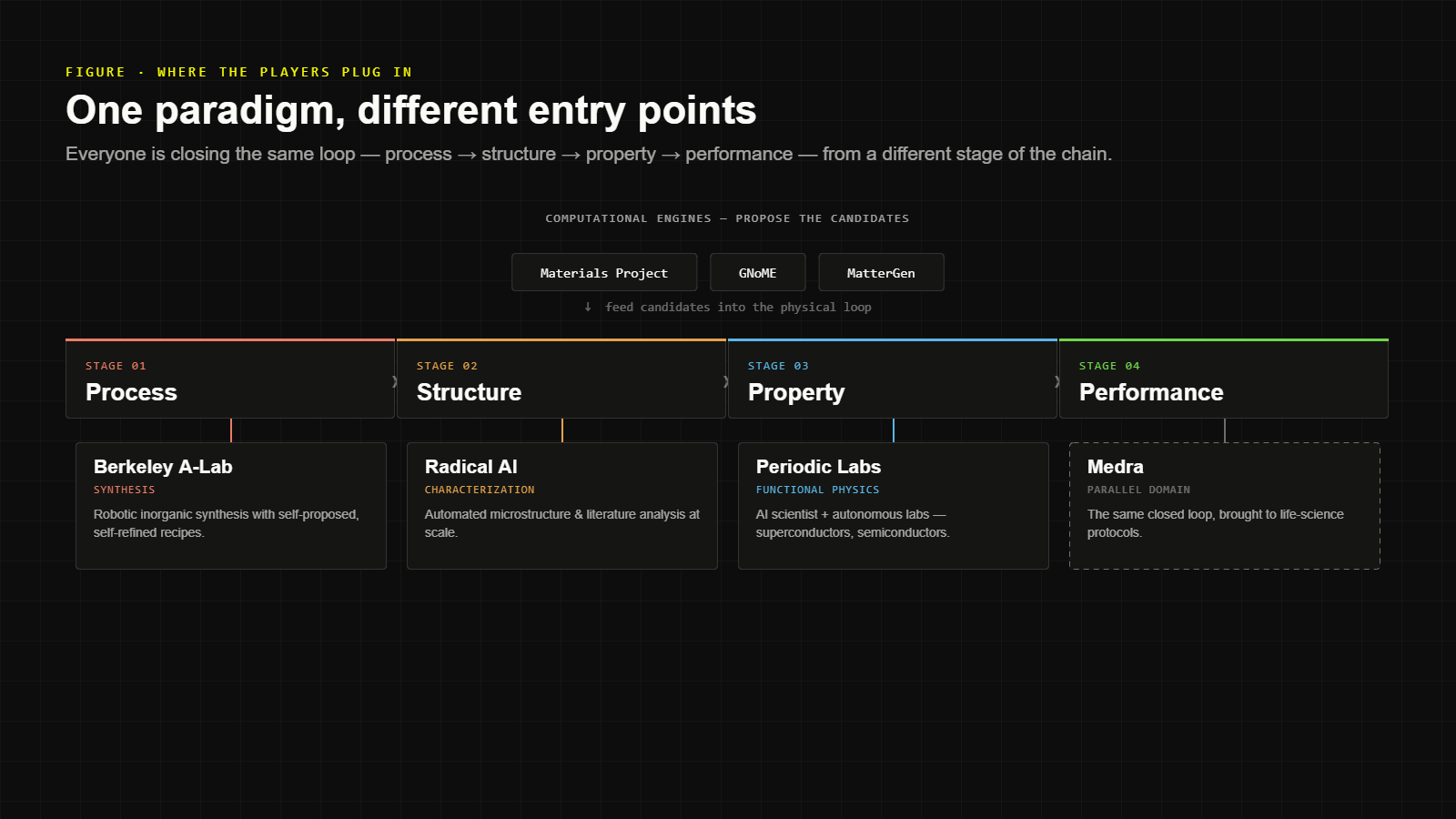
Berkeley's A-Lab anchors the academic frontier in inorganic solid-state synthesis, tightly coupled to open computational databases. Radical AI builds a self-driving lab for mission-critical materials R&D and frames its ambition as artificial general intelligence for science, starting with the built world, with heavy investment in automated microstructure and literature analysis. Periodic Labs, founded by a team that helped build ChatGPT and DeepMind's materials models, is pursuing an AI scientist paired with autonomous labs and starting in the physical sciences, higher-temperature superconductors among the goals, alongside industrial work such as helping a semiconductor manufacturer make sense of heat-dissipation data faster. Medra carries the same closed-loop pattern into the life sciences with a physical AI scientist platform that turns natural-language protocols into robotic execution, already in collaborations with the likes of Genentech.
Underneath all of them sit the open computational engines: the Materials Project, GNoME, and generative tools like MatterGen. They supply the candidates the labs go on to test. The pattern across the whole landscape is the same: encode the science, close the loop, let it compound.
Where this sits in DeepMechanix's thesis
The physical world is bottlenecked on engineering, not on ambition. Almost every hard problem at the core of society, like energy, water, grids, supply chains, eventually resolvee into infrastructure that has to be engineered, checked, and built, and that engineering still runs largely by hand.
DeepMechanix works on the downstream half of that chain: encoding engineering codes and judgement so the calculations, compliance checks, and documentation behind plant design and EPC run in seconds and stay traceable to their source. Autonomous materials discovery is the same thesis applied one step upstream. Where we encode the rules that turn a material into a safe structure, the self-driving labs encode the science that turns an idea into a material. Both are the same loop: encode the judgement, compound the leverage, feed the results back, placed at different points between an atom and a finished plant.
That is why we watch this field closely and build toward it in our own research on physics-informed models and fast engineering surrogates. A future in which new materials arrive in months instead of decades only pays off if the engineering that turns them into infrastructure can keep pace. Closing both loops (discovery and design) is how the physical world starts to move at the speed of the ideas behind it.
Frequently asked questions
What is autonomous materials discovery? Autonomous materials discovery is the use of a self-driving laboratory to run the entire research loop without a human in the middle: an AI proposes a candidate material, robotics synthesize it, automated instruments characterize it, machine learning interprets the results, and the system decides what to try next, then repeats. Berkeley's A-Lab is a leading demonstration.
How is it different from accelerated materials discovery? Accelerated discovery is the broader goal of finding materials faster, often through computational screening and machine learning that shrink the candidate list before any experiment runs. Autonomous discovery is a specific way to achieve it, closing the physical experimental loop so the machine both plans and performs the experiments.
What is the process-structure-property-performance paradigm? It is the central framework of materials science: how a material is processed determines its structure, the structure determines its properties, and the properties determine how it performs in service. Discovery is essentially the inverse problem, starting from a required performance and working back to a process that delivers it.
How much faster is AI-driven discovery? Estimates vary by material class, but the Ceder group targets a rate 10 to 100 times faster than the conventional decade-plus timeline, and its A-Lab synthesized 41 of 58 target compounds in 17 days of continuous operation.
Which companies and labs are working on it? Notable efforts include Berkeley's A-Lab in academia, and companies including Radical AI, Periodic Labs, and Medra, supported by open computational platforms such as the Materials Project, GNoME, and MatterGen.
This piece is a field overview, not investment or research advice. Figures and success rates cited reflect the referenced publications and company statements as of mid-2026.